
IC Substrate Deburring Brushes
The objective of deburring is not to grind away all burrs, but to remove the burrs without altering the base material. The operating window between these outcomes is narrow and depends on the coordination of abrasive particle size, filament diameter, brush compression, and board conveyance speed.
- Roller Brushes
- Disc Brushes
- Wheel brush
- Nylon
- Silicon carbide
- Aluminum oxide
- Configuration
- Wheel brush / Roller brush / Disc brush
- Outer Diameter
- φ60 – φ300 mm
- Filament material
- Abrasive nylon filaments (alumina/silicon carbide) / standard nylon
- Filament Diameter
- 0.20 – 1.00 mm
- Abrasive particle size
- Tiered according to burr height
- Tuft density
- Adjustable
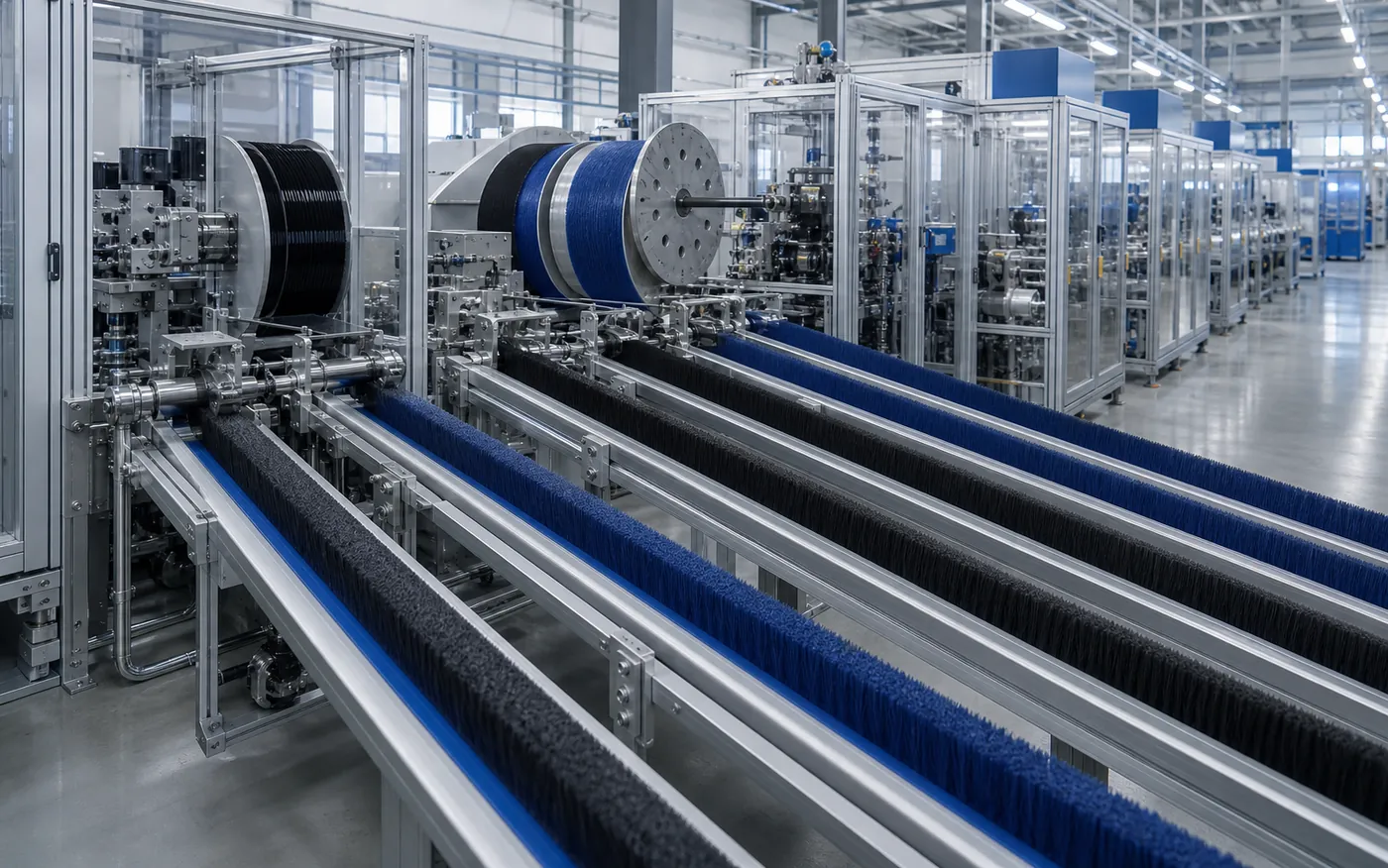
IC substrate deburring brushes are wheel brushes, roller brushes, and disc brushes used to deburr the edges and holes of BT / ABF / FR4 and flexible boards.Common Supply Ranges: Outer diameter φ60–φ300 mm, filament diameter 0.20–1.00 mm, abrasive particle size tiered according to burr height, and adjustable tuft density. Suitable for deburring and hole-mouth finishing of packaging substrates; overly coarse abrasives or excessive pressure can cause over-cutting and steps. Thin substrates should use fine particle sizes with reduced brush compression. The above represents the supplied range rather than material limits. Actual results vary with formulation, brush position, and operating conditions, and shall be verified on the tool using samples.
Why it matters Three essential questions
Burr residue causing subsequent plating defects
The abrasive particle size is too fine or the brush compression is insufficient. Select the particle size according to burr height and confirm the removal rate using samples.
Over-cutting of the base material and dimensional out-of-tolerance
Excessive pressure or overly coarse abrasive. Reduce the brush compression, use finer abrasive filaments, and split the process into two stages.
Directional marks on the board surface
The wheel brush direction does not match the board conveyance direction. Adjust the wheel brush's axial angle and speed ratio to reduce directional marks.
Specification Specification Parameter Ranges
| Parameter | Common ranges / options | Description |
|---|---|---|
| Configuration | Wheel brush / Roller brush / Disc brush | Select according to equipment structure and treatment area |
| Outer Diameter | φ60 – φ300 mm | Wheel brushes commonly use φ100–φ200 |
| Filament material | Abrasive nylon filaments (alumina/silicon carbide) / standard nylon | Abrasive filaments for deburring, standard filaments for cleaning |
| Filament Diameter | 0.20 – 1.00 mm | Coarse filaments for high removal rates, fine filaments for greater uniformity |
| Abrasive particle size | Tiered according to burr height | Coarse grit for high removal rates, fine grit for finishing |
| Tuft density | Adjustable | Density affects the uniformity of grinding per unit area |
| Substrate compatibility | BT / ABF / FR4 / flexible boards | Substrate hardness varies significantly; use separate parameters |
| Board transport speed | Used in conjunction with rotational speed | The equipment speed range must be provided |
| Dynamic balancing | Categorized by rotational speed | Required for high-speed wheel brushes |
| Cooling / dust removal | Vacuum extraction recommended | Chips must be removed promptly |
The table lists common ranges, not extreme values. Actual specifications shall be confirmed according to the brush-position drawing and operating conditions; where specific limits apply, mutually agreed technical documents shall prevail.
Configurations Structural configuration
Deburring wheel brush
The most commonly used type; axially or radially mounted, for processing board edges and hole openings.
Carrier board edge brush
Specifically for the peripheral edges of carrier boards, with a narrow face and high density.
Hole-opening finishing brush
Fine filaments with a small diameter for entering holes to remove burrs around the openings.
Polishing wheel brush
For finishing after deburring and reducing surface roughness.
FAQ Product selection and communication
Can a deburring brush and a polishing brush share the same equipment?
Will abrasive filaments wear away the circuitry?
Is cleaning required after deburring?
Can the wheel brush width be customized to our carrier board dimensions?
Customer requirements
Leave your contact details and requirements so we can get in touch.